Showing posts with label Reviews by Jim. Show all posts

Monday, April 18, 2016

Alexander Hamilton by Ron Chernow

Alexander Hamilton
Alexander Hamilton may be the least known among our country's founding fathers. The two familiar facts of his reputation may be his presence on the ten dollar bill and the sad fact that he perished in a famous duel in 1804. Hamilton was born out of wedlock in the West Indies. There is uncertainty as to the identity of his father. Penniless, he migrated to New York, alone, in his mid-teens. Yet by the age of twenty-two he was the chief of staff to Washington during the American Revolution. He became an essential interpreter and promoter of the US Constitution in the first years of the republic. He was not only founder of the Federalist Party, the US Coast Guard and the New York Post, but as the first Treasury Secretary he implemented financial reforms and programs that secured the future of his young country.

Ron Chernow's biography is considered by many to be the best account of Hamilton's life. It is long and dense but, in the words of one critic, it is that happy rarity, "a popular biography that should also delight scholars." Hamilton's brilliance and foresight shine with dazzling effect in Chernow's storytelling and analyses. If we think that politics and the press are poisoned in our own time, we learn that the modern era may pale beside the vitriol of early America. It was not just reputations that were contested in such contentious times. The founding fathers argued over the direction of the country. There were fundamental differences over executive authority, the implied clause in the constitution, and federal precedence over states' rights  In short time, the two party system would emerge and dominate the politics of American culture. It is this background that leads to the fatal encounter between Aaron Burr and Alexander Hamilton in July of 1804.

In 2015, Chernow's biography became the inspiration for Hamilton, Lin-Manuel Miranda's blockbuster hip hop musical. Miranda read the book while on vacation in 2008. Seven years later, 700 people waited in line for lottery tickets for the opening night preview of his musical on Hamilton's life. While they waited they could have read the book.

Tuesday, March 8, 2016

Notorious RBG: The Life and Times of Ruth Bader Ginsburg by Irin Carmon & Shana Knizhnik

Notorious RBG
Ruth Bader Ginsburg, the second woman appointed to the U.S. Supreme Court, speaks in a soft monotone and is an inch over five feet in height. She will be 83 in April of 2016, and she is still going strong. There may be no better introduction to this remarkable lady than Notorious RBG. The book began as a blog in celebration of the jurist's independence, determination and accomplishments. It's a book that suggests an age of social media with photos, documents, charts, doodles, cartoons, nail art, t-shirts, poems, and a recipe. From its appearance, the immediate audience my be twenty somethings, but anyone who picks it up will be entranced.

It took 192 years for the first woman, Sandra Day O'Connor, to join the U. S. Supreme Court. Ginsburg was appointed twelve years later. The road that each traveled as a woman is invaluable in applying law to all citizens. The experiences of Thurgood Marshall, the first African-American appointed to the nation's highest court, broadened the court's understanding of what it is to be an American. This diversity finally gave real meaning to the Constitution: "We the people, in order to form a more perfect union..."

We know much more about political candidates who run for the Presidency and seats in Congress, but the Supreme Court, with its life appointments, is sacrosanct. When Bob Woodward pierced its secrecy in 1979, he titled his book The Brethren, as if these jurists were members of a male religious order. Ginsburg opened her private life to the authors of Notorious RBG. It's a welcome introduction and a study of how one individual, one woman, can make a difference.

Saturday, February 27, 2016

Mrs. Lincoln and Mrs. Keckly by Jennifer Fleischner

Mrs. Lincoln and Mrs. Keckly
Mrs. Elizabeth Keckly and Mrs. Mary Lincoln first meet in 1861 when Mary's husband is scheduled to take the oath of office.  Mrs. Lincoln wanted fine clothes that would reflect her position as the nation's first lady.  Mrs. Keckly was one of the best and most popular modistes in Washington, and while fulfilling one role, Elizabeth Keckly also became a confident and cherished friend to the president's wife.

The friendship between these two ladies unraveled when Mrs. Keckly published a memoir in 1868.  The book, entitled Behind the Scenes, was a remarkably frank account of her own life.  But it was also a revealing look at the Lincoln White House, one which crossed the "Victorian" codes of friendship and privacy.  Ironically, with this publication, Mrs. Keckly had hoped to gain sympathy and understanding for a controversial first lady.

The author, Jennifer Fleischner, has written chapters which alternate between the two women, both of whom were born in 1818; each is profiled separately and chronologically up to their meeting in 1861.  After 1861, it is a shared story of a remarkable friendship.  Also, it is a great, if unfamiliar, tale in the Lincoln legacy, one which Mrs. Lincoln would write this acknowledgement to her seamstress, a former slave:  "I consider you my best living friend."

Thursday, February 18, 2016

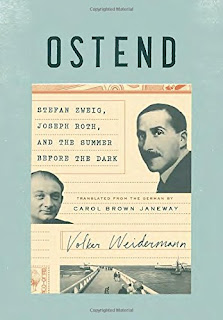
Ostend: Stefan Zweig, Joseph Roth, and the Summer Before the Dark by Volker Weidermann

Ostend
Ostend was a popular resort on the Belgian coast. The Austrian author Stefan Zweig was vacationing there in 1914 when a world war was declared. Years later, Zweig invited Joseph Roth, the Austrian journalist, to join him in Ostend during the summer of 1936. Both men were Jews, emigres, and writers, whose books were banned in much of German-speaking Europe. A small colony of fellow writers, all anti-Fascist, was also in Ostend that summer, commiserating in a tranquil haven before the developing storm: The Spanish Civil War began on July 18. Hitler opened the Berlin Olympics on August 1 with hopes of putting a deceptive face on anti-Semitism. A dictatorship was established in Greece on August 4. The first of the Moscow Purge Trials took place on August 19.

Volker Weidermann, the author of Ostend, is a career journalist who has carefully researched this topic. He introduces his cast of celebrated writers, their writings, and their relationships to one another. He has read their letters, diaries, and memoirs. It's as if he was present during  conversations, the walks they took together, and the cafes they frequented. His subjects become players in a real-life drama. More than one critic has remarked that Ostend is "as transporting as fiction."

Many of these writers did not survive the war years. Most, and perhaps all, of them may be unfamiliar to Americans. But in Europe they all enjoyed literary prominence on the eve of World War II. They are worth knowing. And today, you can't read Ostend without thinking about the emigre experience unfolding daily in our current news. It is this world of today, however, in which Germany has done so much to extend a welcome to emigres seeking peace, protection, and a new life.

Monday, February 1, 2016

Being Mortal by Atul Gawande

Being Mortal
Atul Gawande, a Boston surgeon has now written three bestselling books on the medical field.  Oliver Sacks hailed him as one of "the finest physician writers." Gawande subtitled this work "Medicine and What Matters in the End."  Medicine is the miracle of modern health care.  It has transformed our expectations and eased our worries about childbirth, injury and disease.  We live in a time when people live longer, an older generation anticipates enjoying the golden years being cared for and in reasonable health.

But the end will come, no matter.  Death is the enemy and death will win.  And the simple fact is that modern medicine and the most sophisticated surgical procedures may not always be the best option.  Gawande shares poignant and agonizing stories of his own patients facing mortality.  They include his father who was also a physician.  But these stories also share a sense of peace in the most fateful moments.

While Being Mortal is a clear-eyed look at aging, it is also a candid examination of the medical community.  We rely on doctors to save and extend life in our most advanced years.  But few medical students take classes in geriatrics.  What choices do they give to the elderly at the end of their lives?  Is death even discussed?  What does a doctor, committed to saving life, say when faced with an unfixable problem?  Perhaps Gawande says it best:  "We've been wrong about what our job is in medicine.  We think it is to ensure health and survival.  But really it is about well-being.  And well-being is about the reasons one wishes to be alive."

Also available is the PBS documentary Being Mortal.

Wednesday, January 20, 2016

Isaac's Storm: A Man, a Time, and the Deadliest Hurricane in History by Erik Larsen and Dead Wake: the Last Crossing of the Lusitania by Erik Larsen

Isaac's Storm
I was waiting to read Dead Wake, Erik Larsen's most recent (2015) best seller. This one is on the sinking of the Lusitania.  But I was at the bottom of the request list for the library's copy.  Dead Wake would be a long wait.  So, I read an earlier Larsen story, Isaac's Storm, of an even earlier disaster.  Then, when my turn arrived, I read Dead Wake.

The earlier book, Isaac's Storm, was published in 1999, and it was Larsen's first best seller.  The Washington Post hailed it "the Jaws of hurricane yarns."  The Great Galveston Hurricane reached landfall on September 8, 1900, becoming the deadliest hurricane in U. S. history.  At the time, Galveston, located on little more than a Texas sandbar, was a boom town.  Trade made it prosperous, and success made it complacent.  Coincidentally, the National Weather Service, which became a civilian agency in 1890, didn't like to alarm the public.  Information sharing was severely tested, and tragedy was the result.  The "Isaac" of the story was Isaac Cline, who was the bureau's resident meteorologist in Galveston.
Dead Wake

Larsen likes to tell parallel stories and personal stories too, enriching the narrative.  One parallel story in Dead Wake is how information was amassed by Room 40, a secret group under the British Admiralty, one with access to a German naval code book.  The last voyage of the British-owned Lusitania, we remember, takes place in the first year of World War I.  It was a time when the United States was still neutral.  Larsen asserts that the British were able to track the whereabouts of U-20, the German u-boat that would eventually sink the massive ocean liner with just one torpedo.  Again, the lack of shared information was catastrophic.  Still, the resultant death and destruction was a shameless act of war, certainly a horrific act of terrorism on a civilian populace.  By the way, the term, "Dead wake" is that fading disturbance of water made by a torpedo.

Both tales, both tragedies, are all the more wrenching and inspiring because of the personal stories that Larsen shares.  His research, as always, captures the imagination.  You get to know people: children at play, families together, people and their professions - all at the cusp of a life shattering event.  These individuals accept fate or fight against it, and luck always has a role to play. Both stories read like fiction and are told with detail, insight, and compassion.

Saturday, January 2, 2016

Lincoln: A Novel by Gore Vidal

Lincoln
I had been thinking about this older book this year for two reasons. The year 2015 was an important anniversary, one that was memorialized in Springfield, as the subject of the book was assassinated 150 years ago. A second point of interest was that the author was the subject of a documentary released this year. The documentary is Best of Enemies, and the author in question is Gore Vidal.

To be frank, I was concerned how Gore Vidal would portray Abraham Lincoln. Adding to the concern is the full title of the portrayal, Lincoln: A Novel. It is a fictional account of our sixteenth president. Why read fiction when there are so many acclaimed biographies on this subject? Also, I was well acquainted with Gore Vidal's reputation for being irreverent. Would Lincoln and Vidal be a good fit? Not to worry. The novel offers adroit storytelling and is largely based on fact.  It's drawn from historical accounts: letters, diaries, memoirs, and contemporary newspaper stories. Also, no less a Lincoln scholar than  David Herbert Donald was a consultant. But it's Lincoln. There was criticism along with the acclaim when the novel was published thirty years ago in 1984. 

I enjoyed it immensely. It is skillfully written and, at 657 pages, it's a quick read. Lincoln:  A Novel covers the years of the presidency, 1861-1865. The rich cast of secondary characters (Nicolay and Hay, Seward and Chase, Mrs. Lincoln and Elizabeth Keckley) are richly brought to life. Much of the exposition is in the memorable dialogue that drives the story along. But it is Lincoln, as he should be, who leaves the deepest impression. Vidal creates a multi-dimensional man. And, through one of his characters, the author makes a case for the greatest of presidents, one who was handed a civil war and still managed to remake "an entirely new country, and all of it in his own image." At story's end, Lincoln's good and melancholy company, so human, enlightened, humble and playful, is deeply missed.

Monday, October 12, 2015

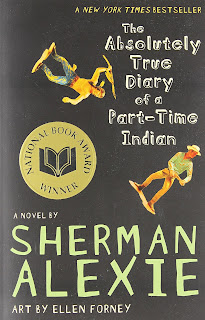
The Absolutely True Diary of a Part-Time Indian by Sherman Alexie

The Absolutely True Diary of a Part-Time Indian
This year Banned Book Week was scheduled for September 27th through October 3rd.  I needed but a day to read a book for young adults, one that has been frequently pulled from school library shelves over the past several years.  The book is titled The Absolutely True Diary of a Part-Time Indian.  It was the first work of young adult fiction by poet and essayist Sherman Alexie.  And it's readily apparent why it has had such a broad appeal to young readers.

Sherman Alexie grew up on the Spokane Indian Reservation where this story is set. It's semi-autobiographical. He knows where from he writes. Physically challenged from hydrocephalus, debilitating fluid in the brain, Alexie excelled academically. He lived on the reservation but attended a white school twenty miles away where he was the only Indian. He was, in his own words, "a part-time Indian." And there-in is the story of the book. We spend an academic year with our fictional fourteen-year-old hero, Arnold Spirit, known as Junior.

They call the reservation "the rez." The inhabitants come and go freely, but it is rare that any of them live elsewhere. And in that isolation there is senseless violence, alcohol addiction, and frequent death. There is also a strong appreciation of community, heritage, and belonging. That any author could sympathetically convey such a sense of environment to young readers is a remarkable achievement.  But there is more. Alexie creates a rich vein of humor combined with a generous sense of inclusion for all his characters. Much of this humor can be found in the cartoons spread throughout the book. The hero, Junior, is an aspiring cartoonist. Sixty-five comic illustrations by Ellen Forney highlight Junior's experiences and feelings. For all the challenges he faces, he responds, in words and pictures, with spunk and hope. "I think the world is a series of broken dams and floods," Junior tells us, "and my cartoons are tiny little lifeboats."

The New York Times may have best summed up this acclaimed book as "listening to your smart, funny best friend recount his day while waiting after school for a ride home." Sherman Alexie received the 2007 National Book Award for Young People's Literature for The Absolutely True Diary of a Part-Time Indian.

Over the Edge of the World by Laurence Bergreen &In the Kingdom of Ice by Hampton Sides

Over the Edge of the World
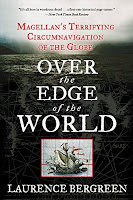
The Age of Discovery did not begin and end with Columbus; there were numerous naval expeditions under that moniker continuing well into the 19th century. One of the earliest and most remarkable was Magellan's search for a westward route to the Spice Islands. His journey (1519-1522) resulted in the first, unexpected circumnavigation of the globe and proved the earth was not flat. Magellan's voyage began with a crew of 270 and 5 ships. Relatively few survived.  Laurence Bergreen tells this story in Over the Edge of the World. He fills in the background of the mission and the details of the journey. It's a story of mutinies, starvation, orgies, and an epic adventure in navigational skills. Magellan's expedition changed how Europe thought of the world and how it conceived of new lands and people to conquer.

In the Kingdom of Ice
More than 350 years later, explorations were funded not by kings but by the press to give them a story. Such was the case with the voyage of the USS Jeannette, financed in large part by the New York Herald. In 1879, Captain George Washington DeLong set sail with a crew of 32 and headed toward the uncharted Arctic. At the time, there was a common belief that once a ship was past the ice, it could sail through the Bering Strait and reach navigable waters in the Arctic. Merchants would be able to sail across the North Pole. The theory proved faulty, and the Jeannette was crushed and sank. The crew took to the ice, hence the book's title, In the Kingdom of Ice.  From a time of incredible, death-defying adventures, Hampton Sides vividly recreates this largely forgotten tale.

Both books promise spellbinding adventure!

Saturday, August 1, 2015

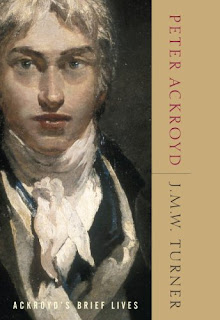
J. M. W. Turner by Peter Ackroyd

J. M. W. Turner
Mike Leigh's movie, Mr.Turner, premiered just last year. It's a film about the career of the great British Romanticist landscape painter, J. M. W. Turner (1775-1851). The critics praised it but many viewers were challenged by the central performance (Turner was gruff and lacking in social skills), the chronology of his life (did the story cover five years or twenty?), and the length of the movie (2 1/2 hours). It's a beautiful piece of filmmaking and it made me more curious about the artist. 

I knew of Turner's paintings but not much about his life, so I went to the library shelves and discovered Peter Ackroyd's J. M. W. Turner, the second biography in the author's Brief Lives series. It's all of 160 pages, but it tells the full story.  (Leigh tells us that his movie only focuses on the final twenty-five years of Turner's life.)

So, who was Turner? He was the son of a barber/wigmaker and, due to the mother's mental instability, the father who raised him. His talent for art was recognized early and at the age of fifteen his work was exhibited at the Royal Academy of Art. By the time he was in his early twenties he had begun to focus on landscape and particularly maritime studies. He was as accomplished with watercolor as he was with oil. Fortunately, he had the support of some well-heeled patrons and he was a good businessman. Financial success gave him independence and that independence gave him the freedom to be more experimental. Turner's expressionist studies in light, color, and atmosphere were unmatched in his time and these works predate the Impressionists by decades.

If you are curious, the Ackroyd Brief Lives biography is a good place to start. The library has many additional books that reproduce his art including J. M. W. Turner: Painting Set Free (2014), the exhibition catalog for a show that has traveled from the Tate (London) to the Getty (Los Angeles) and is now on view at the Fine Arts Museum in San Francisco.

And then there is Mr.Turner, Mike Leigh's movie, also available for loan from the library.

Tuesday, July 21, 2015

Book of Ages by Jill Lepore & Benjamin Franklin by Walter Isaacson

Book of Ages
The reading of two books began with one discovery. I had seen a title of a book lying on its side. Pulling it from a stack of books out of curiosity, the book was Book of Ages. It's the story of Benjamin Franklin's youngest sister, and the subtitle is The Life and Opinions of Jane Franklin. In a family of seventeen children, he was the youngest son and she was the youngest daughter. As children, they were known as Benny and Jenny, and they would remain close throughout their long lives. From humble beginnings, the brother would go on to international fame and be among the founding fathers of the United States. Jane would marry at fifteen, be the mother of twelve, and spend a lifetime as a caretaker of her family. With no formal education, Jane learned to read and write and correspond with her famous brother. Their histories, their letters, and their deep affection for one another are the basis of this memorable study by Jill Lepore (The Secret History of Wonder Woman). So many women's lives in the past are footnotes in the biographies of others. Lepore share's Virginia Woolf's sense of gender inequality in asking:  what if William Shakespeare had a sister? What if she had a genius equal to his? What would have been her future? Fortunately, Lepore is able to reconstruct Jane Franklin Mecom's life story.  But we can only wonder what Jane's life might have been if given opportunities.

Benjamin Franklin
Also on a shelf, my own, was a copy of Walter Isaacson's Benjamin Franklin:  An American Life. So, my reading went from Jenny to Benny. The Isaacson biography is much acclaimed and with good reason. How often Franklin is portrayed as the jester, the kite-flyer, "Cher Papa" with the ladies, the man with a ready quip from Poor Richard's Almanack. He is an easy subject for caricature. But his was a long, incredibly productive life. The sweep of that journey - as printer, scientist, inventor, political theorist, author, statesman, diplomat - reminds us that Franklin had no equal in his own time or since. Among the founding fathers, his humble start in life and his unwavering belief in democracy and tolerance helped define the country. His was a vision of  a country that would avail opportunities for all, a country where all were to be equal. Benjamin Franklin stands alone as the only person to have signed all four of the documents which helped create the United States, from the Declaration of Independence to the Constitution. Walter Isaacson's book is a reminder of a unique and highly accomplished life, a life that was absolutely vital in the early years of our country. It also happens to be an enjoyable and satisfying read.

Thursday, May 14, 2015

All the Light We Cannot See by Anthony Doerr

All the Light We Cannot See
"Open your eyes and see what you can with them before they are closed forever." That's a line from Anthony Doerr's All the Light We Cannot See. The protagonists in this novel are a blind French girl and a German boy who is an engineering prodigy. But both of them, in their youth, will be challenged to see, to face, the moral dilemmas of their time. The novel is set in the period leading to World War Two, the war years, and many years later.

The novel opens in August 1944, but the story shifts back and forth in time, preparing us for the moment when these two young lives converge, when two people, on opposite sides of the war, find goodness in one another.  I should add that the book doesn't end with that encounter and the shifting time narrative only adds to the suspense.

Anthony Doerr's novel had become a publishing sensation, striking a chord with a wide readership.  It is, after all, emotionally involving with an engrossing story, memorable characters and situations, and, at over 500 pages, a quick and satisfying read.  It is also told without sentiment and a wonderful sense for detail. There is a locksmith who builds intricate boxes, a search for a rare jewel, an indoctrination at a Hitler Youth camp, and a vividly described tall house located by the sea at Saint-Malo - a house with a special history of its own. When it didn't receive the National Book Award, All the Light We Cannot See became even more topical. It was part of the news. Then, it went on to win the 2015 Pulitzer Prize for Fiction.

Thursday, May 7, 2015

Deep Down Dark by Hector Tobar

Deep Down Dark
In 2010, in a northern desert area of Chile, the San Jose mine collapsed. There were 33 miners trapped deep underground and the massive explosion blocked their escape. For a long time no one knew if there were survivors. Then a drill bore a narrow hole into a chamber and when the bit was hoisted back a note was attached. It read "We are well" and signed "The 33." There was a global audience as attempts were made to rescue the men over a 69 day period.

While there is no secret to the story's conclusion, Hector Tobar's account is suspenseful and riveting.  He weaves together a tale of endurance, family anguish, massive publicity, and self-serving politics.  Novelist Ann Patchett described this true story as "a masterpiece of compassion." Tobar puts the reader in the mine - deep down dark - to share the experience of entrapment with the miners. We share their danger, their fears, their hunger, and their disagreements. The cavern where they gathered was both their coffin and their church. This experience and its telling rates with the best of adventure tales, one with many moral lessons.

The Lady in Gold by Anne-Marie O'Connor

The Lady in Gold
The movie is titled Woman in Gold.  But first came the book, The Lady in Gold, by journalist Anne-Marie O'Connor. Both titles refer to Gustav Klimt's iconic 1907 portrait of Adele Bloch-Bauer.  This work was the first of two paintings of the artist's lady friend and patron. Some Austrians consider it the equivalent of their Mona Lisa. When Austria was annexed by Germany in 1938 the Bloch-Bauer properties - including five Klimt paintings - were confiscated by the Nazi state. Family members were sent to concentration camps. It was not until six decades later that surviving relatives were able to seek restitution. After years of legal wrangling, the five paintings were returned in 2006. The chief crusader in this victory was Maria Altmann, the niece of Adele Bloch-Bauer.

O'Connor's book offers an excellent background on Jewish life in turn of the century Vienna. She profiles the Bloch-Bauer family members, their fortunes and individual fates. And she takes time to detail the many complications of a restitution argument and how the case was won.

The Lady in Gold, Portrait of Adele Bloch-Bauer I, sold in 2006 for $135 million.

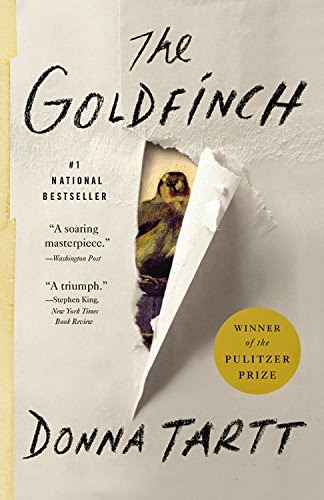
The Goldfinch by Donna Tartt

The Goldfinch
The Goldfinch is Donna Tartt's third novel in twenty years. The title refers to Carel Fabritius' 17th-century painting, portraying a bird perched on top of its feeder with a leg chained to prevent flight. The story of the novel unfolds as a first person account by a young man, Theo Decker, who begins the tale when a terrorist bomb explodes in a New York museum.  He is thirteen at the time of the incident. He and his mother are visitors at the museum, and the mother is killed. With the explosion, the painting comes into Theo's possession. Remembering his mother's admiration of the painting, he hides the painting, reluctant to part with it. Over the next decade Theo and the painting journey from New York to Las Vegas to New York to Amsterdam. Will he be the hero of his story? Contemplating themes of fate and character, he seems to come to terms with his life so far.

The first impressions of this book may be of the writing, described by critics as "intoxicating," "elegant," and "breathtaking." Tartt's stories are always driven by her characters and each character is fully, richly developed. Her descriptions plant a vivid image of personality and manner of speaking. There are detours and distractions in the story but every detail matters, each fitting into what is a masterpiece of storytelling that deservedly won the Pulitzer Prize for Fiction in 2014.

Tuesday, November 18, 2014

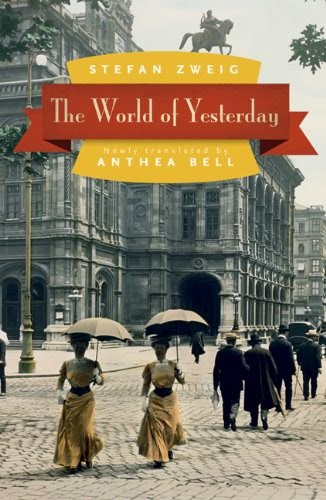
The World of Yesterday by Stefan Zweig

The World of Yesterday
Earlier this year, Wes Anderson could be heard discussing the life of Stefan Zweig (1881-1942), whose literary works helped shape the storyline of Anderson's movie The Grand Budapest Hotel.  Whether you see Zweig's influence or not, Anderson did a great service in promoting a long neglected writer.  In his time, Zweig was a widely read and popular author with an international following.  An Austrian-Jew, European culture was the center of his world, a world that collapsed with the rise of Nazi-socialism.  Zweig fled to London, then New York, and finally to Brazil where he committed suicide.  His posthumous autobiography, The World of Yesterday, was published in English in 1943.  It's a book in which Zweig holds a mirror to the past, recounting a changing society, remembering friendships from Herzl to Freud, and sharing, with nostalgia and grace, a world lost forever.  Europe's fate, and his own, is inescapable and suggested in the closing paragraph:  "Homeward bound I suddenly noticed before me my own shadow as I had seen the shadow of the other war behind the actual one.  During all this time it has never budged from me, that irrevocable shadow..."

For anyone interested in the life and legacy of Stefan Zweig, there is no better place to start than The World of Yesterday.  Then read the novellas, the short stories, the biographies and the essays of Stefan Zweig.  More and more of them are being republished as readers rediscover one of the most universally admired writers of the early 20th-century.

Wolf Hall and Bring Up the Bodies by Hilary Mantel

Wolf Hall
When Hilary Mantel's Wolf Hall was published in 2009, it won the Mann Booker Prize.  When the sequel, Bring Up the Bodies, was published in 2012, it also won the Mann Booker Prize.  The final issue of the projected trilogy, The Mirror and the Light, is scheduled to be published in early 2015.  There is great anticipation - and expectation - for any book to follow such acclaimed predecessors.

The subject of this trilogy, which is biographical fiction, is Thomas Cromwell, a minister to King Henry VIII.  Cromwell rose from humble origins to become the right-hand man to Cardinal Wolsey and then succeeded Wolsey as the king's most powerful minister (1532-1540).  In the shark-infested waters of the English court, Cromwell is never
Bring Up the Bodies
allowed to forget that he was born the son of a blacksmith.  But with pragmatism, intelligence and talent he manages to navigate through the turmoil of his time:  a king's divorce, a king's marriage, a queen's beheading, the Reformation.

As one who prefers biography to historical fiction, I found Mantel's novels to be an extraordinary achievement - a total immersion in 16th-century England with an exacting knowledge of personalities and conflicts.  The bonus here is the level of writing, writing to be read again, read aloud, read to be shared.