Monday, May 11, 2015

Virgin River by Robyn Carr

Virgin River
The main character, Mel, has gone through a very difficult period in her life. Since the tragic death of her husband, she has struggled to return to her “normal” life in LA. She feels that her only solution is to get away from the big city and move to small town life. Thus, nearly on a whim, she moves to Virgin River where she can continue her midwifery, assist the elderly doctor, and try to work through her personal pain with anonymity.

When Mel first arrives in town, she is shocked to see that the promised accommodations are not at all habitable. Faced with this, she decides that she cannot stay and will be leaving the next morning. However, as she is about to drive out of town, a newborn baby is found abandoned on the doctor’s doorstep. With this shocking turn of events, she makes the decision to stay until the mother can be found. Through the course of events to follow, Mel not only works through her pain but also allows love to enter back into her life. 

Romance fans will find a winner with this read.

Thursday, May 7, 2015

Deep Down Dark by Hector Tobar

Deep Down Dark
In 2010, in a northern desert area of Chile, the San Jose mine collapsed. There were 33 miners trapped deep underground and the massive explosion blocked their escape. For a long time no one knew if there were survivors. Then a drill bore a narrow hole into a chamber and when the bit was hoisted back a note was attached. It read "We are well" and signed "The 33." There was a global audience as attempts were made to rescue the men over a 69 day period.

While there is no secret to the story's conclusion, Hector Tobar's account is suspenseful and riveting.  He weaves together a tale of endurance, family anguish, massive publicity, and self-serving politics.  Novelist Ann Patchett described this true story as "a masterpiece of compassion." Tobar puts the reader in the mine - deep down dark - to share the experience of entrapment with the miners. We share their danger, their fears, their hunger, and their disagreements. The cavern where they gathered was both their coffin and their church. This experience and its telling rates with the best of adventure tales, one with many moral lessons.

The Lady in Gold by Anne-Marie O'Connor

The Lady in Gold
The movie is titled Woman in Gold.  But first came the book, The Lady in Gold, by journalist Anne-Marie O'Connor. Both titles refer to Gustav Klimt's iconic 1907 portrait of Adele Bloch-Bauer.  This work was the first of two paintings of the artist's lady friend and patron. Some Austrians consider it the equivalent of their Mona Lisa. When Austria was annexed by Germany in 1938 the Bloch-Bauer properties - including five Klimt paintings - were confiscated by the Nazi state. Family members were sent to concentration camps. It was not until six decades later that surviving relatives were able to seek restitution. After years of legal wrangling, the five paintings were returned in 2006. The chief crusader in this victory was Maria Altmann, the niece of Adele Bloch-Bauer.

O'Connor's book offers an excellent background on Jewish life in turn of the century Vienna. She profiles the Bloch-Bauer family members, their fortunes and individual fates. And she takes time to detail the many complications of a restitution argument and how the case was won.

The Lady in Gold, Portrait of Adele Bloch-Bauer I, sold in 2006 for $135 million.

The Goldfinch by Donna Tartt

The Goldfinch
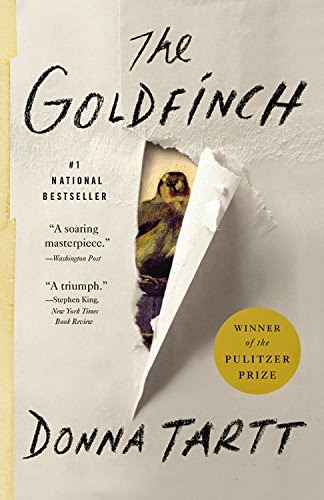
The Goldfinch is Donna Tartt's third novel in twenty years. The title refers to Carel Fabritius' 17th-century painting, portraying a bird perched on top of its feeder with a leg chained to prevent flight. The story of the novel unfolds as a first person account by a young man, Theo Decker, who begins the tale when a terrorist bomb explodes in a New York museum.  He is thirteen at the time of the incident. He and his mother are visitors at the museum, and the mother is killed. With the explosion, the painting comes into Theo's possession. Remembering his mother's admiration of the painting, he hides the painting, reluctant to part with it. Over the next decade Theo and the painting journey from New York to Las Vegas to New York to Amsterdam. Will he be the hero of his story? Contemplating themes of fate and character, he seems to come to terms with his life so far.

The first impressions of this book may be of the writing, described by critics as "intoxicating," "elegant," and "breathtaking." Tartt's stories are always driven by her characters and each character is fully, richly developed. Her descriptions plant a vivid image of personality and manner of speaking. There are detours and distractions in the story but every detail matters, each fitting into what is a masterpiece of storytelling that deservedly won the Pulitzer Prize for Fiction in 2014.

Wednesday, May 6, 2015

The Paying Guests by Sarah Waters

The Paying Guests
After losing both brothers in WWI and her father shortly thereafter, Frances Wray can no longer support herself or her mother, and both are at risk of losing their majestic home in a wealthy suburb of London. Forced to take in borders to help pay the bills, Lillian and Leonard Barber, a boisterous young couple from the lower clerical caste, move into the upstairs rooms and quickly alter the staid, reserved atmosphere in the house. Initially, Leonard appears charming and vibrant, even if there is something about him that Frances does not trust. She does, however, find Lillian's bohemianism to be a welcome change. Everything moves along smoothly for a time, but then incidents begin to happen that make Frances question whether the Barbers' marriage is truly a happy one. Embroiled in the Barbers' affairs, Frances can sense tragedy is coming but has no idea how unprepared she is for the consequences nor the things she will agree to for love...

1922 was a tumultuous time. Unemployment was high after WWI, and gender and class inequalities were dramatically shifting causing uneasiness throughout London. Waters uses this edgy backdrop to mirror and escalate the instability inside the Wrays' home. Fans of historical fiction, postwar fiction, romance, and crime novels will find much to like. If you enjoyed The Paying Guests, check out more of Sarah Water's works and my personal favorite, The Night Watch.

Monday, April 20, 2015

Smile by Raina Telgemeier and Sisters by Raina Telgemeier

Smile
Beginning with Smile, Raina recounts her early teenage years in San Francisco, how she severely injured her two front teeth and the horrific surgeries, braces, headgear, and fake teeth that resulted. Not only does she go through all of these dental woes while trying to be just an average teenager, but she also deals with boy trouble, frenemies, her annoying younger sister, and one very frightening earthquake. The vibrant and colorful graphics make this an absolute fun read, and kids, or even adults, won't have any trouble identifying with her struggles.
Sisters

Sisters, naturally, focuses on the relationship Raina has with her younger sister, Amara. The two cannot get along for any reason, but then their younger brother is born and their parents start acting strangely. Over the course of a road trip from San Francisco to Colorado for a family reunion, both sisters know they need to band together but are having a hard time changing how they act. This is a much more sparse graphic novel with simple black and white line drawings compared to the brightly colored and detailed drawings in Smile, but Sisters is still well worth the short time it takes to read.

Discussing family, relationships, and the angst of growing up, these two stories are highly recommended for children on up to adults. If you like Smile or Sisters, be sure to check out Drama, also by Telgemeier.

Monday, April 13, 2015

An Appetite for Violets by Martine Bailey

An Appetite for Violets
This light historical novel tells the traveling adventures of Biddy Leigh, who in 1772 is happy in her position as an undercook at a large British estate and is about to marry her beau. Unfortunately, Biddy and a few other servants are recruited by the newly wedded Lady Carinna to travel with her to her uncle's villa in Italy after a spat with her husband. Considering the lengthy trip, their party pauses in France to rest, and Biddy begins to experience and appreciate the wonders of fine cuisine, documenting and adding recipes to The Cook's Jewel, a household book of recipes. Throughout the trip, Lady Carinna confides more and more secrets with Biddy, who looks remarkably like the Lady herself. Eventually, Biddy is obligated to comply with Lady Carinna's desperate machinations but is unaware of the great danger she will face as a result of her complicity.

Each chapter begins with a recipe out of The Cook's Jewel that directly relates to Biddy's cooking in the chapter to come. The ending is rather predictable if one pays attention to the generous hints along the way, but readers who enjoy historical tales or novels about food will find much to like in An Appetite for Violets. Bon appétit!